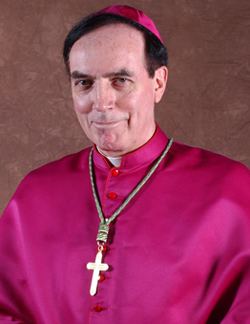
It is with great sadness that I write these lines in honor of Henry Mansell, a shepherd with whom I had the privilege to work throughout his entire tenure as Archbishop of Hartford.
I served as Music Director of the Archdiocese and of the Cathedral of Saint Joseph at the time of his installation, and during those years I witnessed firsthand what I can only describe as one of the most visionary episcopacies I have ever known.
When Archbishop Mansell arrived, the cathedral’s music program was modest—faithful, but limited. He immediately saw something greater. Just one week after his arrival, we presented a concert in memory of Michael Conard featuring the Requiem by Maurice Duruflé, performed by 150 singers alongside the New Haven Symphony Orchestra. The cathedral was filled beyond capacity—so much so that we had to close the doors, and traffic backed up on Interstate 84. It was not merely a concert; it was a sacred moment, one of the most powerful in the cathedral’s musical history.
The next day, Archbishop Mansell called me personally. His words were simple but transformative: “Ezequiel, I want more of these concerts. I want the cathedral not only to be the mother church of the archdiocese, but also a cultural center for the city of Hartford.” That vision became a reality.
Under his leadership, the cathedral became a beacon of sacred and symphonic music. We presented monumental works: symphonies by Anton Bruckner, the Te Deum by Hector Berlioz, Symphony No. 2 by Gustav Mahler, the Requiem by Giuseppe Verdi, the Symphony No. 3 by Henryk Górecki, the Organ Symphony by Camille Saint-Saëns, and the Organ Concerto by Francis Poulenc, among many others. Great orchestras, international artists, and distinguished organists from places such as Saint-Sulpice and Notre-Dame Cathedral brought extraordinary artistry to Hartford.
But his vision extended beyond concerts. Archbishop Mansell understood that sacred music must live at the heart of the liturgy. With his support, we established the Schola Cantorum, a professional choir that elevated the musical life of the cathedral. We also founded the Solideo Gloria Orchestra and a brass quintet to serve the great liturgies of the Church.
He encouraged outreach across the archdiocese: consulting with parishes, installing and restoring pipe organs, relocating instruments from closing churches, and even sending a container with two pipe organs and three pianos to an archdiocese high in the Andes of Peru. He supported the creation of the Office of Sacred Music—something that had never existed before—ensuring that every liturgy was prepared with care, dignity, and beauty.
Archbishop Mansell was not only a patron of music; he was deeply knowledgeable. He knew hymnody, history, and repertoire with remarkable precision. I recall a “game” we often played during major liturgies: as the Gospel was proclaimed, I would search for a hymn that reflected its message, improvising on it as he processed to the pulpit. Without prior planning, he would arrive and name exactly the hymn I had chosen—sometimes even identifying it as Pange Lingua, written by Thomas Aquinas. His intellect and musical memory were extraordinary.
It is fitting that I write this on Good Shepherd Sunday. Archbishop Mansell truly embodied the Good Shepherd. He listened deeply—so deeply that conversation with him could feel one-sided at first. But when he spoke, his words were precise, insightful, and exactly what was needed.
He was a tireless worker. He began his days before 7:00 a.m., celebrating daily Mass at the cathedral—a Mass he himself established—and grounding his ministry in prayer before all else.
Archbishop Mansell transformed not only a cathedral, but an entire culture of sacred music. His legacy is not only in the institutions he built, but in the countless lives he inspired, the beauty he fostered, and the faith he strengthened through music and worship.
May he rest in peace, and may his example continue to guide all who seek to serve the Church with excellence, vision, and devotion.
Mourning the Loss of Archbishop Henry Mansell